

A Podiatrist’s Guide to Diabetic Foot Care
In this article:
A blister from a new pair of shoes usually isn’t a big deal. If you have diabetes, though, that small blister can quietly turn into a serious wound. That’s why diabetic foot care is one of the most important parts of managing diabetes.
November is American Diabetes Month, so it’s the perfect time to give your feet some attention. Below, Dr. Chase Witter, podiatrist at CMC Orthopaedics, explains why diabetes puts your feet at risk. He also shares simple habits that can protect them.
Worried about your feet? Dr. Chase Witter offers diabetic foot exams and expert wound care at CMC Orthopaedics in Conway. Call 843-347-8041 or request an appointment online.
Why Diabetes Puts Your Feet at Risk
Diabetes affects your feet in two main ways. First, high blood sugar can damage nerves, a condition called diabetic neuropathy. As a result, you may not feel a cut, a blister, or a pebble in your shoe.
Second, diabetes can reduce blood flow to your legs and feet. Your feet are already the farthest point from your heart. So when circulation slows, even small wounds heal more slowly and are more likely to become infected.
The numbers show why this matters. According to an American Diabetes Association (ADA) task force, the lifetime risk of developing a foot ulcer may be as high as 25% for people with diabetes. In addition, the ADA reports that an American loses a limb to diabetes every four minutes.
The good news? Many of these complications can be prevented with daily care and regular checkups.
Dr. Witter has seen that difference firsthand. Before podiatry school, he worked as a certified nursing assistant in a long-term care facility. There, he watched a podiatrist heal stubborn wounds and help patients keep their limbs.
“I realized there’s not many things more rewarding than healing a wound and helping somebody keep their limb,” Dr. Witter says.
Your Daily Foot Check, Step by Step
A daily foot check takes about a minute. Choose a time that fits your routine, like after your shower or before bed. Then follow these steps:
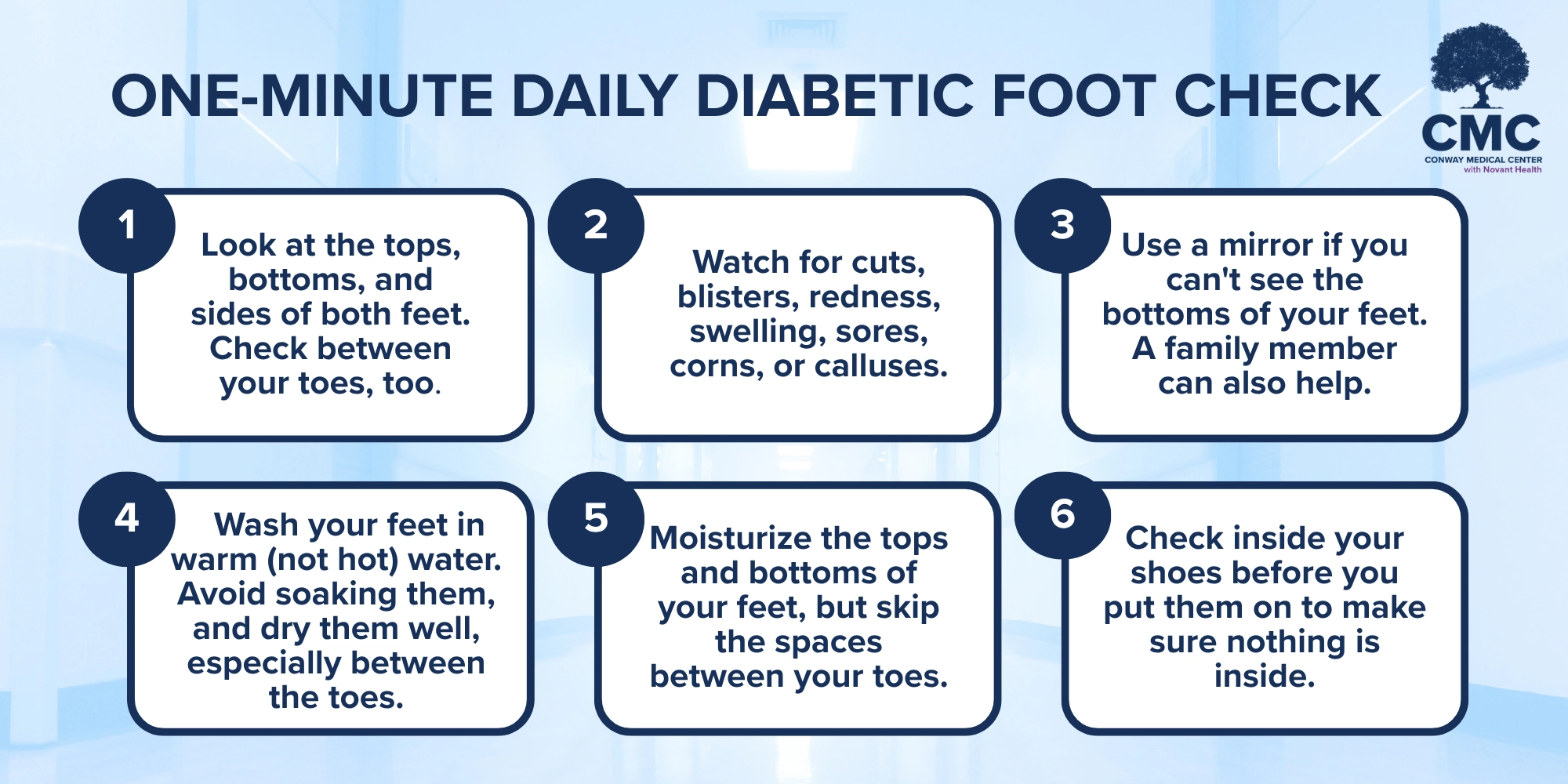
A few everyday habits make a big difference, too:
- Never walk barefoot, even at home or on the beach.
- Wear socks and shoes that fit well and don’t rub.
- Trim toenails straight across. If that’s hard for you, your podiatrist can help.
- Keep your blood sugar, blood pressure, and cholesterol in your target range.
- Wiggle your toes and move your ankles a few times a day to keep blood flowing.
Living with diabetes? Dr. Chase Witter can help you build a foot care plan that protects your feet for the long haul. Call CMC Orthopaedics at 843-347-8041 or request an appointment online.
Warning Signs You Shouldn’t Ignore
Because diabetes can dull pain, your feet may not warn you the way they should. That’s why it’s important to watch for changes you can see. Call your podiatrist or doctor right away if you notice:
- A cut, blister, or sore that isn’t healing
- Redness, warmth, or swelling
- Drainage or a bad smell from a wound
- Skin color changes, especially dark or bluish areas
- Numbness, tingling, or burning
- An ingrown toenail or a nail that looks infected
- Pain or cramping in your legs during activity
- Changes in the shape of your foot
“With diabetes, you can’t always count on pain to warn you,” Dr. Witter says. “If something looks different, call us. We’d much rather see you early.”
Also, seek care right away for signs of a serious infection. These include fever, redness that spreads, or a wound that gets worse quickly.
Why Routine Podiatry Visits Make a Difference
Your primary care provider should check your feet at regular visits. However, a podiatrist brings a deeper level of foot and ankle expertise. The American Podiatric Medical Association recommends that people with diabetes have a podiatrist check their feet once a year or more.
At CMC Orthopaedics, diabetic foot care includes:
- Comprehensive foot exams that check nerve function and circulation
- Routine nail care, including thick or fungal toenails
- Treatment for corns, calluses, and ingrown toenails
- Wound care for diabetic foot ulcers
- Guidance on footwear, orthotics, and daily skin care
- Coordination with CMC vascular specialists when circulation is a concern
Wound care is where Dr. Witter’s passion really shows.
“Wound care is my baby,” he says. “I love taking care of diabetic foot wounds. My favorite thing is the healing process- no wound is the same, and it’s so fulfilling to see my patients finally healing from wounds that some have had for a very long time.”
Meet Dr. Chase Witter
Dr. Chase Witter is a podiatrist at CMC Orthopaedics in Conway. As a foot and ankle specialist, he treats everything from the toes to the ankle. That includes diabetic foot care, wound care, ingrown toenails, plantar fasciitis, bunions, sports injuries, and more.
Dr. Witter earned his medical degree from Kent State College of Podiatric Medicine. He then completed three years of surgical residency training at Ascension St. Vincent. Even so, he always starts with the simplest treatment that works, from footwear changes to stretching exercises. Minimally invasive procedures and surgery are there when patients truly need them.
His approach? Listen first. For patients who need ongoing diabetic care, that means having a partner who’s easy to talk to.
“I’m always willing to listen,” Dr. Witter says. “You can tell me whatever’s on your mind during your appointment.”
When he’s not caring for patients, Dr. Witter is busy being a dad to four kids. He’s also the reigning hide-and-seek champion of his household.
Don’t wait for a small problem to become a big one. Schedule a diabetic foot exam with Dr. Witter at CMC Orthopaedics, 2376 Cypress Circle, Suite 300, in Conway. Call 843-347-8041 or request an appointment online.
Your feet carry you through every part of life. With daily care and a trusted podiatrist on your side, you can keep them healthy for years to come. Dr. Witter and the CMC Orthopaedics team are here to help you stay on your feet and keep doing what you love.
Key Takeaways
- Diabetes can cause nerve damage and poor circulation, so foot injuries may go unnoticed and heal slowly.
- A one-minute daily foot check is one of the best ways to catch problems early.
- Never walk barefoot, and wear shoes that fit well.
- Call right away if you see a sore that won’t heal, redness, swelling, or drainage.
The content within this article and others on this website is only for educational purposes and should not be considered medical advice. For any questions or concerns, please consult with your healthcare provider.
Sources:
-
American Diabetes Association. “American Diabetes Association Teams Up With Dr. Comfort To Take Next Step in Preventing and Managing Foot Complications.” https://diabetes.org/newsroom/american-diabetes-association-teams-up-dr-comfort-to-take-next-step-preventing-managing-foot-complications
-
American Podiatric Medical Association. “Take Charge of Your Diabetes: Healthy Feet.” https://www.apma.org/files/Diabetes-Feet-h.pdf
-
Boulton, A.J.M., et al. “Comprehensive Foot Examination and Risk Assessment.” Diabetes Care, 2008. https://pmc.ncbi.nlm.nih.gov/articles/PMC2494620/
-
Centers for Disease Control and Prevention. “Tips for Healthy Feet.” https://stacks.cdc.gov/view/cdc/251984
-
Pharmacy Times. “Top 5 Ways to Reduce the Risk of Diabetic Foot Ulcers.” https://www.pharmacytimes.com/view/top-5-ways-to-reduce-the-risk-of-diabetic-foot-ulcers