Lung Cancer Screening: How It Works, From Your First Scan to Answers
In this article:
Lung cancer is the leading cause of cancer deaths in the U.S. In fact, it takes more lives than breast, prostate, and colon cancer combined. One reason is that it often causes no symptoms until it has already spread.
That’s where screening comes in. A quick, painless scan can find lung cancer early, when it’s easier to treat. Still, many people put it off because they aren’t sure what to expect.
Here, we walk you through the lung screening program at Conway Medical Center step by step. You’ll learn how to qualify, what happens during your scan, and how Dr. Hafez Hayek and Dr. Snigdha Sharma of CMC Pulmonary & Sleep Medicine help if something needs a closer look.
Could you be at higher risk for lung cancer? Talk to your primary care provider about a referral for lung cancer screening at CMC. For pulmonology appointments, call CMC Pulmonary & Sleep Medicine at 843-234-6888.
Step 1: Find Out If You Qualify
Lung cancer screening is for people at higher risk who don’t have symptoms. At CMC, you qualify if you meet all of the following:
- You’re between 50 and 80 years old.
- You currently smoke, or you quit within the past 15 years.
- You have a smoking history of at least 20 pack-years.
- You have no signs or symptoms of lung cancer.
What’s a Pack-Year?
A pack-year is a simple way to measure how much you’ve smoked over time. To figure it out, multiply the number of packs you smoked per day by the number of years you smoked.
For example:
- 1 pack a day for 20 years = 20 pack-years
- 2 packs a day for 10 years = 20 pack-years
- Half a pack a day for 40 years = 20 pack-years
Talk With Your Doctor
Next, you’ll have a conversation with your primary care provider. Together, you’ll go over the benefits and risks of screening and decide if it’s right for you.
If you decide to move forward, ask your provider to send a referral to CMC. Then, our team will contact you to schedule your scan.
Bring This Guide to Your Doctor
To help things move quickly, print our Lung Screening Referral Guide and take it to your next appointment. It shows your doctor exactly what CMC needs to confirm you qualify, place the screening order, and refer you to a lung specialist if needed. When your doctor sends everything at once, you can avoid delays and get answers sooner. In fact, CMC’s goal is to take patients with a lung nodule from first finding to diagnosis in under 21 days.
Have questions along the way? CMC’s Lung Health Navigator can help. Call 843-234-8652.
What About Cost?
Lung cancer screening is covered by Medicare and most private insurance plans for people who qualify. However, some plans have their own age ranges, so it’s a good idea to check with your insurance provider first.
Step 2: Your Low-Dose CT Scan
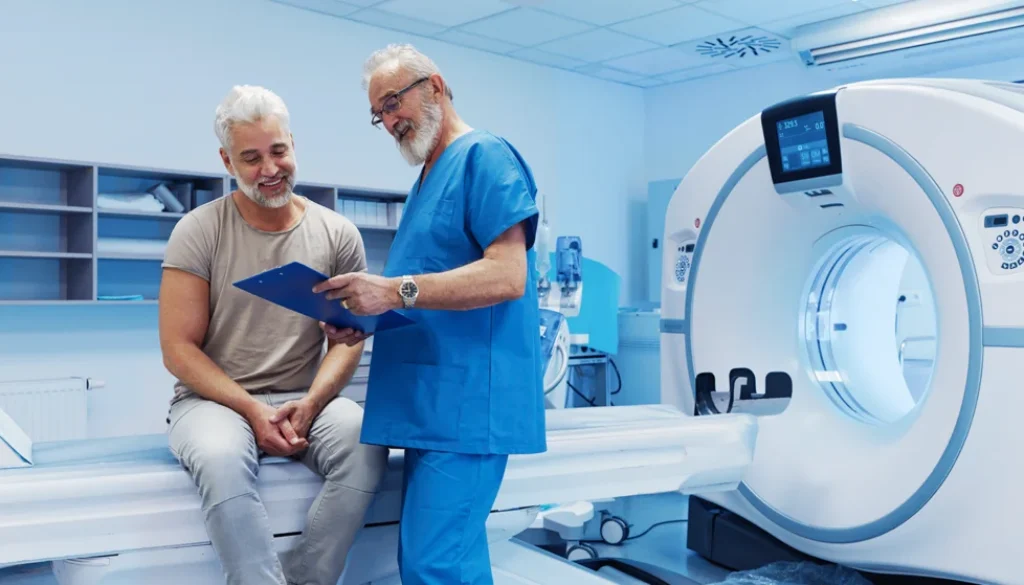
Lung cancer screening uses a low-dose CT scan, also called an LDCT. It takes detailed pictures of your lungs using much less radiation than a standard CT. In addition, it doesn’t require any contrast dye or needles.
How to Prepare
- Arrive early: Plan to get there about 30 minutes before your appointment.
- Eat normally: There’s no need to fast. You can eat and drink as usual.
- Dress comfortably: Wear loose clothing without metal, like zippers or underwire. You may be asked to change into a gown.
- Leave valuables at home: That way, you won’t have to keep track of them.
- Plan for kids: Children can’t come into the exam room, so bring someone to watch them if needed.
What Happens During the Scan
The whole visit usually takes about 15 minutes, and the scan itself lasts only a couple of minutes. You’ll lie on your back on a table that slides through a large, open, ring-shaped machine. The technologist will ask you to hold your breath for a few seconds while the images are taken.
That’s it. It’s quick, painless, and you can go right back to your day.
Step 3: Understanding Your Results
After your scan, a radiologist reviews the images and sends the results to your doctor. Your results will usually fall into one of these groups:
- Normal: Nothing concerning was found. You’ll come back for another scan in a year.
- Likely harmless: Small spots, called nodules, were found but don’t look like cancer. You may simply return in a year.
- Needs a closer watch: A nodule should be checked again sooner. Your doctor may order a follow-up scan in a few months to see if it changes.
- Needs more testing: A nodule looks suspicious. In this case, you’ll be referred to a lung specialist for next steps.
Don’t Panic If a Nodule Is Found
Getting a call about a nodule can feel scary. However, lung nodules are very common, and most of them are not cancer. Many are simply small scars from past infections.
That’s why careful follow-up matters. It helps your care team tell the difference between a harmless spot and one that needs attention.
Early detection saves lives. If you’re at higher risk for lung cancer, ask your primary care provider about screening at CMC. Questions about getting started? Call our Lung Health Navigator at 843-234-8652. For pulmonology appointments, call CMC Pulmonary & Sleep Medicine at 843-234-6888.
Step 4: If a Nodule Needs a Closer Look
A CT scan can show that a nodule is there. However, it can’t tell for sure whether that nodule is cancer. The only way to know is to take a small tissue sample, called a biopsy.
At CMC, that’s where Dr. Hayek and Dr. Sharma come in. They use a procedure called bronchoscopy to reach nodules through your natural airways, with no incisions.
What Is Bronchoscopy?
During a bronchoscopy, the doctor guides a thin, flexible tube through your mouth and down into your airways. This lets them see inside your lungs and collect tissue samples.
CMC also offers Ion robotic-assisted bronchoscopy. This advanced technology uses an ultra-thin, robot-guided tube to reach even tiny nodules, some as small as a pea, deep in the outer parts of the lungs.
Before Your Procedure
- Planning: First, your doctor uses your CT scan to build a 3D map of your airways and plan the best route to the nodule.
- Fasting: You’ll be asked not to eat or drink for several hours beforehand. Your care team will tell you exactly when to stop.
- Medicines: Let your doctor know about all medicines you take, especially blood thinners.
- A ride home: Because you’ll receive anesthesia, plan to have someone drive you home.
During Your Procedure
You’ll be fully asleep under general anesthesia, so you won’t feel anything. Using the 3D map, your doctor guides the tube to the nodule. Then, they collect several samples from different angles to get the most accurate results.
If needed, your doctor can also check nearby lymph nodes during the same procedure. This can help answer important questions without a second visit.
After Your Procedure
Ion bronchoscopy is an outpatient procedure, which means most people go home the same day. Most patients get back to normal activities within a day or two.
For a day or two, it’s normal to have:
- A sore throat or hoarse voice
- A mild cough
- Feeling a bit tired
Throat lozenges or warm salt-water gargles can help ease a sore throat. However, call your doctor right away if you have a fever, chest pain, trouble breathing, or cough up more than a small amount of blood.
Getting Your Results
Your tissue samples are sent to a lab for testing. Afterward, your care team will go over the results with you and talk about next steps. If cancer is found, finding it early often means more treatment options and better outcomes.
Meet Your Pulmonary Team
If your screening shows something that needs a closer look, you’ll be in experienced hands at CMC Pulmonary & Sleep Medicine.
Dr. Hafez Hayek is board-certified in internal medicine, pulmonary disease, interventional pulmonary medicine, critical care medicine, and sleep medicine. He also holds a Certificate of Added Qualification in Advanced Diagnostic Bronchoscopy from the American Association for Bronchology and Interventional Pulmonology.
Dr. Snigdha Sharma is board-certified in pulmonary disease and internal medicine. She performs a full range of diagnostic procedures, including bronchoscopy, endobronchial ultrasound (EBUS), and CT-guided biopsy.
In addition, CMC is recognized as the #1 hospital in the market for COPD care, and it was the first hospital in the greater Conway area to offer Ion robotic bronchoscopy.
Where to Find Us
CMC Pulmonary & Sleep Medicine 8004 Myrtle Trace Drive, Suite 200, Conway Phone: 843-234-6888 | Fax: 843-234-6889
CMC also has a second pulmonary office at CMC Pulmonary & Sleep Medicine – Church Street, 2701 Church Street, Suite D, Conway.
A physician referral is required for new patients. Ask your primary care provider to fax a referral to 843-234-6889.
Early detection saves lives. If you’re at higher risk for lung cancer, ask your primary care provider about screening at CMC. For pulmonology appointments, call CMC Pulmonary & Sleep Medicine at 843-234-6888.
Thinking about lung cancer can be scary. But knowing what to expect can make the process much easier. From your first scan to your final answers, the team at CMC Pulmonary & Sleep Medicine is here to guide you every step of the way. If you qualify, don’t wait. A few minutes today could make all the difference.
Key Takeaways
- Lung cancer often has no early symptoms, so screening can find it before it spreads.
- You may qualify if you’re 50 to 80, have a 20 pack-year smoking history, and smoke now or quit within 15 years.
- Screening uses a quick, painless low-dose CT scan with no needles or contrast dye.
- Most lung nodules found on screening are not cancer.
- If a nodule needs a closer look, a bronchoscopy can collect a tissue sample through your airways.
- CMC’s Ion robotic bronchoscopy can reach nodules as small as a pea, and most patients go home the same day.
- Dr. Hayek and Dr. Sharma at CMC Pulmonary & Sleep Medicine guide you through every step.
The content within this article and others on this website is only for educational purposes and should not be considered medical advice. For any questions or concerns, please consult with your healthcare provider.
Sources
American Cancer Society, “Do You Need Lung Cancer Screening?” https://www.cancer.org/content/dam/cancer-org/cancer-control/en/booklets-flyers/do-you-need-lung-cancer-screening.pdf
American Lung Association, “What to Expect from a Lung Cancer Screening,” https://www.lung.org/lung-health-diseases/lung-disease-lookup/lung-cancer/screening-resources/what-to-expect-from-lung-cancer-screening
Kaiser Permanente, “Bronchoscopy: What to Expect at Home,” https://healthy.kaiserpermanente.org/health-wellness/health-encyclopedia/he.bronchoscopy-what-to-expect-at-home.tw12595
MedlinePlus, “Bronchoscopy – Aftercare,” https://medlineplus.gov/ency/patientinstructions/000988.htm